China recorded roughly 132 million inbound visits in 2024, a 61% jump from 2023, with foreign nationals accounting for about 40.6 million entries — a surge the National Immigration Administration attributes largely to an expanded visa-free policy that by year-end covered 38 unilaterally exempted countries. Beijing itself logged 1.02 million foreign visitors in just the first half of 2024, up 257% year-on-year. A city seeing that kind of rebound is also a city where the older “one main airport” assumption no longer holds — arriving on a long-haul flight from outside the region makes planning around jet lag worth doing before the two-airport system adds its own confusion.
Getting there
Beijing now runs a genuine two-airport system. Beijing Capital International Airport (PEK), 24.22 km from downtown, was the sole major hub for decades and still carries a large share of international long-haul traffic. Beijing Daxing International Airport (PKX), 47.82 km out, opened on September 25, 2019, and has grown fast: it served just over 3 million passengers in its partial first year but reached 53.6 million in 2025, according to Wikipedia’s aggregated traffic data. Which one you land at depends entirely on your airline and alliance — Star Alliance and most legacy carriers still concentrate at Capital, while several Chinese carriers (China Southern, China Eastern) have shifted a meaningful share of routes to Daxing. Check your specific flight’s airport code rather than assuming; don’t book ground transport until you know which one you’re using. Tianjin Binhai International Airport (TSN), 121.72 km away, is a separate city’s airport and not a practical option for a Beijing-based trip.
Where to base yourself
Dongcheng district, especially around Wangfujing, is the standard first-timer base — it puts the Forbidden City, Tiananmen Square, and the Wangfujing pedestrian shopping street within walking distance, and keeps the Lama Temple and the Drum and Bell Towers a short subway ride away. Travelers with more time and a preference for atmosphere over convenience often choose a courtyard hotel in the hutong areas around Gulou or Nanluoguxiang, trading a few minutes of transit time for staying inside Beijing’s old residential fabric. Sanlitun, in Chaoyang district, is a better fit if nightlife, international dining, and a more contemporary Beijing are the priority over proximity to the historic sites.
Getting around
The Beijing Subway opened its first 21 km section on October 1, 1969 — coincidentally the 20th anniversary of the People’s Republic — making it the oldest metro system in mainland China; it remained restricted to official use until opening to the public in 1977. The network has since become one of the largest in the world: 30 lines and roughly 909 km of track as of a December 2025 expansion, carrying more than 10 million riders a day. For a typical visitor itinerary, Line 1 (running east-west past Tiananmen) and Line 5 (north-south through the Lama Temple area) cover most of what matters. The historic core between Tiananmen and the Forbidden City is walkable, but Beijing’s blocks are large by design — plan for more walking time between subway exits and gates than the map distance suggests.
What’s actually worth your time
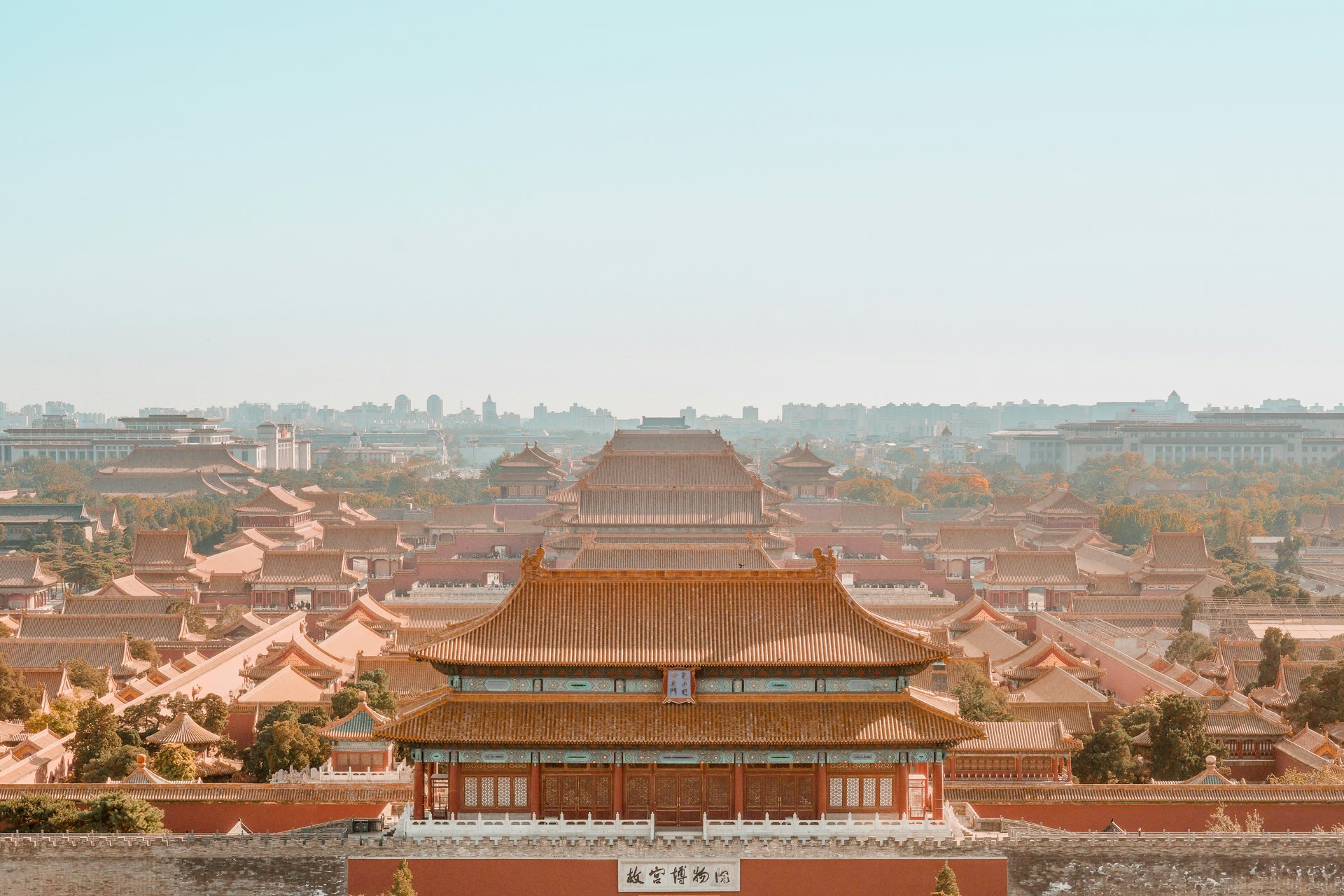
The Forbidden City and the Palace Museum are the same physical site, not two separate attractions — the Forbidden City is the Ming-and-Qing-era palace complex, built 1406–1420 and covering 106 hectares, while the Palace Museum is the museum institution established there on October 10, 1925, after the last emperor, Puyi, was moved out following the 1911 revolution. UNESCO listed the complex as a World Heritage Site in 1987. Budget at least half a day; the 1.17 million-piece art collection recorded in a 1925 audit means the museum galleries alone can absorb hours beyond a walk-through of the palace grounds.
The Monument to the People’s Heroes, an obelisk on Tiananmen Square unveiled in 1958, is a quick 30-minute stop that pairs naturally with a Forbidden City visit since it sits directly on the walking route to the south gate.
Yonghe Temple (the Lama Temple), begun in 1694 as a princely residence before Emperor Qianlong converted it into one of China’s most significant Tibetan Buddhist monasteries, houses a Maitreya Buddha carved from a single sandalwood trunk — 26 meters total height, with 18 meters above ground — recognized as the largest single-piece wooden Buddha statue in the world.
Prince Gong’s Mansion, confiscated from the disgraced official Heshen after Emperor Jiaqing had him executed in 1799 and later granted to Prince Gong under Emperor Xianfeng, is the largest and best-preserved Qing-dynasty princely residence in Beijing, spanning 60,000 square meters between its courtyard buildings and garden. It reopened as a public museum in 2008 after a restoration costing 200 million yuan.
Round out a slower day with Shichahai, the lake district just north of the Forbidden City lined with bars and traditional courtyard homes, or Purple Bamboo Park, a quieter public garden further from the tourist core — both work better as a change of pace than as headline destinations.
Planning note
Beijing’s must-see sites cluster into two zones: the Forbidden City/Tiananmen axis in central Dongcheng, and the hutong belt around Gulou/Shichahai just north of it. Group your days by zone rather than attraction type — trying to do the Forbidden City and Prince Gong’s Mansion on the same day works geographically, but pairing either with Sanlitun means a deliberate subway trip across town, not a casual add-on. For the hutong days, which are mostly spent walking outdoors, check the Beijing air-quality forecast alongside the weather.
Sources
- National Immigration Administration data via English.www.gov.cn — China’s inbound tourism continues heating up
- Global Times — China records 20.115m visa-free entries in 2024
- Wikipedia — Beijing Daxing International Airport
- Wikipedia — Beijing Subway
- Sixth Tone — 100 Years Ago, Beijing’s Forbidden City Opened Its Doors
- Wikipedia — Forbidden City
- Wikipedia — Yonghe Temple
- Visit Beijing — Prince Gong’s Mansion: The largest residence in the Qing Dynasty
- Lonely Planet — Discover the best neighborhoods to visit in Beijing
Planning a wider trip across the region? See the Asia Trip Cost Breakdown for how a Beijing stop fits into a multi-country budget.